Asia · Japan
Tokyo Broth and the Discipline of Silence
A single bowl in a 9-seat counter in Yotsuya. What a perfect dashi teaches about restraint, lineage, and listening.
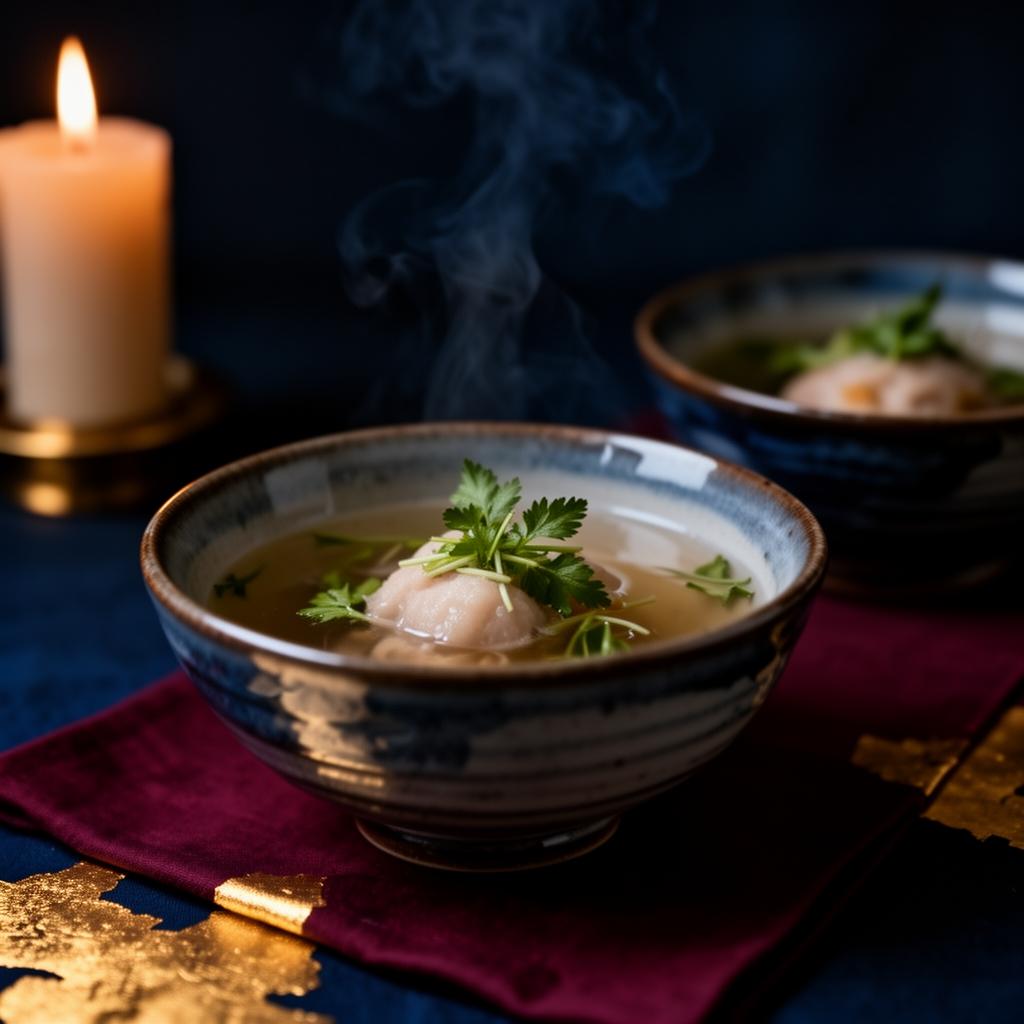
Yotsuya · A nine-seat counter at the blue hour
There is a small room in Yotsuya where nobody speaks. Nine stools, a hinoki counter, a chef whose hands move at the speed of water. He does not greet you. You do not greet him. The water is on. The bonito is breathing. The first lesson of the morning is that you have arrived inside something that was already happening.
I have eaten dashi in eleven cities. In Kyoto where it is monastic, in Osaka where it is louder than people admit, in Fukuoka where it carries a different fish, in São Paulo and Lima where the Japanese diaspora has translated it into a southern grammar. But the dashi in Yotsuya is the only one that has ever made me put my pen down.
The chef begins at 5:30 with the konbu, which has been resting in cold water since the night before. He does not heat it aggressively. He raises the temperature the way a careful father raises his voice. There is a point — somewhere around 60°C — where the konbu has given everything it intends to give and beyond which it begins to take back. He pulls it out at that point. He does not check the temperature. He knows.
Then the katsuobushi. The shavings are translucent, almost violet at the edges. He drops them in. They sink. They pause. They rise. He waits. He strains. This is the entirety of the dashi.
The lifting of katsuobushi — Tokyo, 6:42am.
If you have made dashi at home, you know that nothing is technically difficult here. There is no technique. There is only the question of when to do the next thing. Dashi is a discipline of timing dressed up as a recipe. The recipe is a distraction.
What the chef in Yotsuya understands — and what makes his nine-seat room a quiet kind of temple — is that timing cannot be taught. It must be inherited or it must be earned by a kind of attention that costs years.
He earned it for thirty-six years. He worked in a kaiseki kitchen in Kyoto for twelve. He worked in a soba shop in Nagano for six. He worked alone in his current room for eighteen. The dashi I drank that morning was the inheritor of all of those years, and it tasted like none of them in particular. It tasted like an attention that had become a person.
The bowl arrives without comment. There is no garnish. There is no second component. The dashi is the dish. You are meant to lift the bowl with both hands, bring it to your mouth, and drink. You are meant to not say anything for the duration of the drinking.
Konbu rehydrating in cold water overnight. The first sound of the day.
I have heard people, after the bowl, try to describe what they tasted. They reach for words like 'oceanic' and 'mineral' and 'umami,' and the words feel grossly inadequate, the way English always does when a Japanese kitchen has stopped translating. The bowl is not a flavor. The bowl is an event in time.
What I have learned, after four mornings at that counter, is that the dashi is not the point. The point is the silence around it. The dashi is the instrument by which the silence becomes audible.
This is the hardest lesson in Japanese cuisine and the one most often skipped. The dish is not the dish. The dish is what the silence has chosen to lean against in order to become hearable. Sushi is the silence leaning against fish. Soba is the silence leaning against buckwheat. Dashi is the silence leaning against the sea itself.

The bowl, arriving without comment. The dashi listens before it speaks.
I want to argue, against the grain of every Michelin guide I have ever read, that this is a higher art than most of what gets called fine dining in Europe. Not because it is more complex. Because it is more honest about what cooking actually is.
The remaining 12 paragraphs are reserved for The Adept readers.
BINA 369 is a serious editorial archive. The first 12 paragraphs are offered freely. The full essay — including the symbolic margins, source notes, and closing argument — is held inside the membership ring.
The full archive of 365+ essays unsealed.
Unlocks every essay, including this one.
The study hall, the symbol vault, the inner room.
Required tier for this essay.
Free 12 of 24 paragraphs · No advertising, ever · Cancel inside the ring
From the same continent
Continue reading
A Five-Continent Theory of Soup
Pho, harira, borscht, sancocho, gumbo. Every soup is a small map of the people who keep it warm.
Street Food as Truth Serum
A city lies in its restaurants and confesses in its street food. A field manual from Bangkok, Mexico City, and Naples.
The Hidden Language of Spice
Cardamom is a vowel. Cumin is a consonant. Saffron is punctuation. A grammar of the world's pantry.